

"Even the invisible parts demand meticulous attention." The making of a duckbill strap.
Scissor Case -WW- Ducker Strap Production Process
The ducker strap may appear to be "just cut straight" at first glance.
However, in reality, each one is carefully crafted through many steps and processes.
Production Steps
① Laminate leather and create curves
Two pieces of leather are glued together and neatly trimmed.
At this time, they are glued with a slight curve to follow the body of the scissor case.
This is because if they are glued straight, it will be difficult for them to fit when attached.
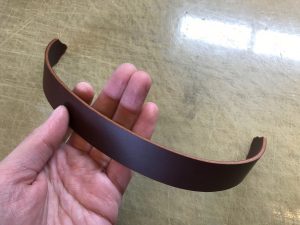
At this point, the edges of the cross-section (coba) are sharp, giving an unfinished impression.
② Shaving the edges of the coba
The edges are hand-shaved using a tool called an edger.
When well-maintained tools are used, the cross-section is smoothly shaved, adding beauty to the finish.
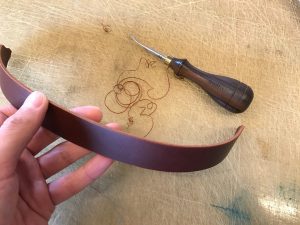
③ Sanding and polishing
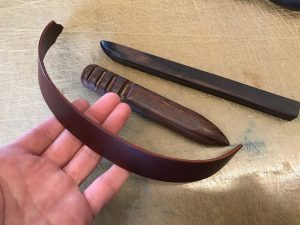
The strap is carefully sanded to achieve a natural texture.
Then, a special agent is applied to polish the cross-section and suppress fluffing.
Finally, a transparent finishing agent is applied to reinforce the cross-section.
④ Finishing and sewing
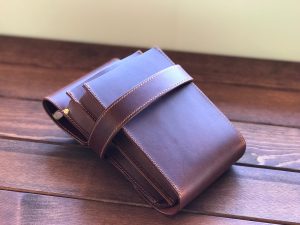
Finally, the strap is securely fixed by sewing with a sewing machine.
This is a measure to ensure long-term, worry-free use, as adhesive alone is not sufficient.
Even a small part is imbued with many processes and thoughts
It may be difficult to convey in photos, but if you compare it to the first image, you can see that the cross-section has a smooth and glossy finish.
In this way, the beauty and usability of the entire scissor case are created by meticulously crafting even just one strap.
I hope that reading this article will make you feel a little more attached to your companion scissor case.
Tanaka, BLINK SCISSORS CASE